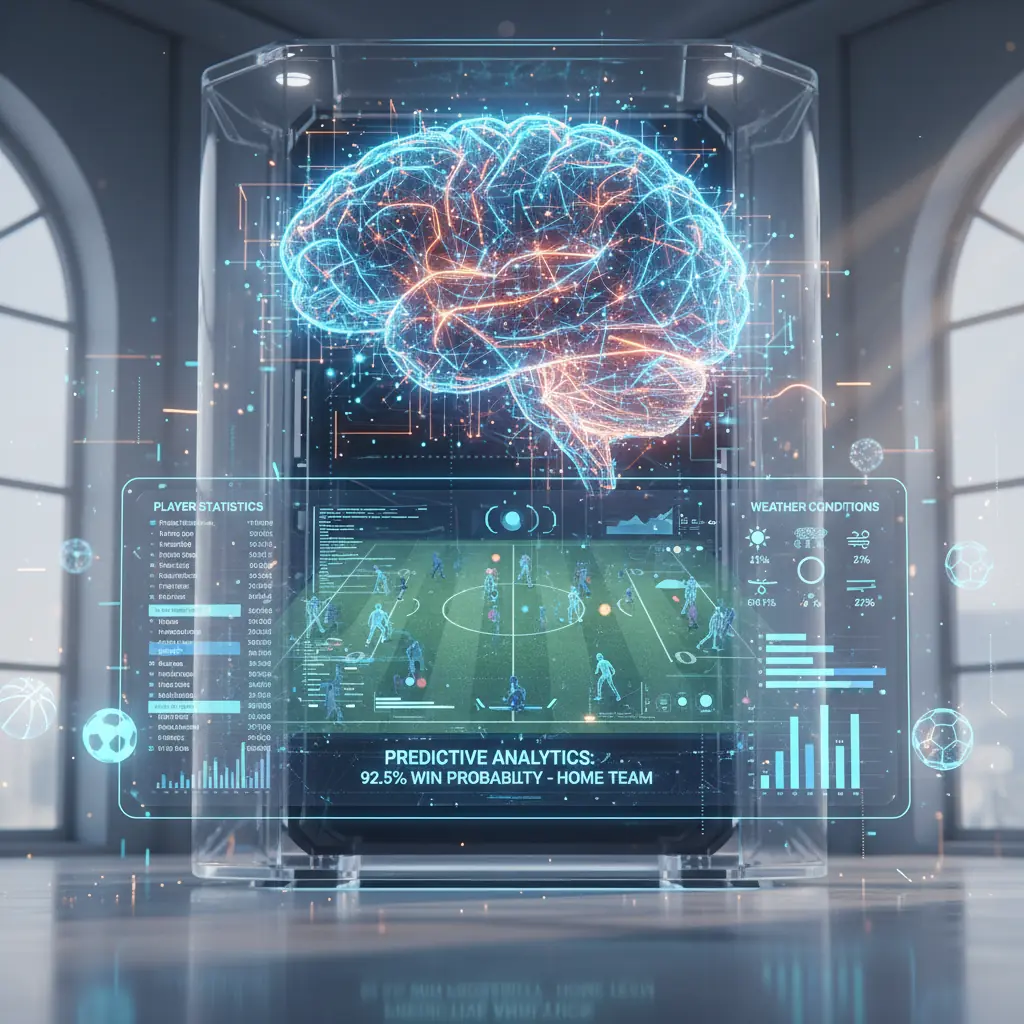
Imagine a world where predicting the outcome of sports events isn’t just guesswork, but a science fueled by artificial intelligence. What if you could harness the power of algorithms to gain a competitive edge? AI is rapidly changing the game in sports prediction, moving it from hunches and historical data to sophisticated machine learning models. The accessibility of these powerful AI tools is growing, empowering everyone from casual fans to serious analysts.
This guide dives deep into how AI is revolutionizing sports analytics. Whether you’re looking to refine your betting strategy, enhance your fantasy league performance, or simply understand the future of sports, get ready to unlock the potential of AI and gain a whole new perspective on the games we love.
The AI Revolution in Sports: A New Playing Field
Artificial intelligence is no longer a futuristic concept; it’s a present-day reality reshaping the sports landscape. From the grand stages of professional leagues to the training routines of individual athletes, AI’s influence is undeniable and constantly expanding. It’s not just about crunching numbers anymore; it’s about fundamentally changing how sports are played, analyzed, and experienced.
The adoption of AI and machine learning in sports analytics has exploded in recent years. Professional sports teams are leveraging these technologies to gain a competitive edge, making data-driven decisions that were once impossible. For example, player performance is being meticulously tracked and analyzed, uncovering hidden strengths and weaknesses with incredible precision. This allows coaches to tailor training regimens and game strategies with unprecedented accuracy.
AI is also revolutionizing how athletes are scouted. Advanced algorithms sift through vast amounts of data, identifying promising talent that might otherwise go unnoticed. These systems analyze everything from game footage to biometric data, providing a more comprehensive and objective evaluation of an athlete’s potential. This is transforming the way teams build their rosters, ensuring they have the best possible talent on the field.
The shift toward data-driven decision-making is perhaps the most significant impact of AI in sports. Teams are now relying on sophisticated analytics to optimize player positioning, predict opponent strategies, and even minimize the risk of injuries. This is not to say the human element is being removed from the game, but it is being augmented by the power of AI, creating a new era of strategic depth and competitive intensity.

AI in Action: Real-World Applications and Examples
Artificial intelligence is rapidly transforming the world of sports, moving beyond theoretical concepts to deliver tangible benefits on and off the field. From enhancing player performance to refining game strategies, AI applications are providing a competitive edge to teams and enriching the fan experience. Predictive analytics, powered by AI algorithms, is at the forefront of this revolution, enabling teams to make data-driven decisions that were once considered impossible. In the NFL, AI is used to analyze player movements, predict potential injuries, and optimize training regimes tailored to individual needs. NBA teams leverage AI to scout opponents, identify weaknesses in their defense, and develop offensive strategies to exploit those vulnerabilities. In Major League Baseball, AI algorithms sift through vast datasets to evaluate player performance, predict pitch types, and optimize batting lineups for maximum run production. These are just a few examples of how AI is reshaping the sports landscape, offering unprecedented insights and opportunities for improvement.
Sports data APIs are also crucial enablers in this field. They provide access to a wealth of real-time and historical information, including player statistics, game outcomes, and even biometric data. This data fuels AI models, allowing them to learn patterns, make predictions, and provide valuable insights that can be used by coaches, trainers, and team management. These APIs offer functionalities such as live scores, player tracking, and detailed event data, ensuring that AI algorithms have the most current and relevant information.
Injury Prevention Tactics With AI
AI excels at predicting injuries related to overuse, biomechanical imbalances, and fatigue. For example, AI algorithms analyzing movement patterns can detect subtle changes that indicate a player is at risk of a hamstring pull or ACL tear. Several teams and leagues are quietly using AI-powered systems to monitor player workload, sleep patterns, and nutritional intake. Imagine a scenario where an AI system, after analyzing data, flags a star wide receiver as being at high risk of a soft tissue injury due to accumulated fatigue. By adjusting his training schedule and incorporating targeted recovery protocols, the team avoids a potentially season-altering injury. This proactive approach represents a significant shift in sports medicine, moving from reactive treatment to proactive prevention, all thanks to the power of AI.
Understanding the Fundamentals: How AI Predicts Sports Outcomes
Artificial intelligence is rapidly changing how we understand and interact with sports. At its core, AI sports prediction relies on machine learning, a powerful tool that allows computers to learn from data without explicit programming. Think of it as teaching a computer to recognize patterns in sports data to forecast future outcomes. This process involves feeding vast amounts of information into AI models, enabling them to identify subtle relationships that humans might miss. The end goal is to make informed predictions about game results, player performance, and even potential injuries.
Data analysis is the lifeblood of any AI-driven sports prediction system. The more data available, the more accurate the predictions tend to be. This data comes in many forms, including player statistics (points scored, assists, rebounds, etc.), game footage, weather conditions, and even social media sentiment. Some companies are even using computer vision models to analyze game footage, tracking player movements and ball trajectories with incredible precision. This visual data provides another layer of insight for AI models, adding depth to traditional statistical analysis.
Several machine learning algorithms are commonly employed in sports prediction. Regression models are used to predict continuous variables, such as the number of points a player will score. Classification algorithms are used to predict categorical variables, such as whether a team will win or lose. Neural networks, inspired by the human brain, are particularly effective at handling complex, non-linear relationships within the data. They can learn intricate patterns that traditional algorithms may overlook, making them a popular choice for cutting-edge sports prediction systems. These algorithms become refined over time as new data is made available.
Key Performance Indicators in AI Sports Prediction
Key Performance Indicators (KPIs) are vital for gauging the success of AI sports prediction models, going beyond simple win/loss accuracy. Statistics that are most indicative of success can vary. For a basketball player, it might be a combination of points per game weighted by usage rate and defensive rebounds, while for a hockey goalie, save percentage and goals-against average might be more insightful. Current KPI metrics are foundational for effective model building, while looking for hidden metrics is vital for a competitive edge.
Accuracy and Limitations: Demystifying the Numbers
AI’s predictive capabilities are impressive, but it’s crucial to understand that these predictions aren’t infallible. Several factors influence AI accuracy, including data quality, model complexity, and the unpredictability of real-world events. Initial datasets may contain errors, inconsistencies, or insufficient information, leading to skewed or unreliable predictions. More complex AI models don’t always guarantee superior accuracy; they can sometimes overfit the data, performing well on training sets but poorly on new, unseen data. External factors, such as unexpected player injuries, weather conditions, or even plain luck, can significantly impact game outcomes in ways that AI models may not anticipate.
Data bias is another critical concern. If the data used to train an AI model reflects existing biases (e.g., historical underrepresentation of certain player demographics), the model may perpetuate those biases in its predictions. Mitigating bias requires careful data curation, model explainability techniques, and ongoing monitoring to ensure fairness and equitable outcomes. While AI is a powerful tool, human analysts often outperform AI in situations requiring nuanced judgment, contextual understanding, and the ability to adapt to unforeseen circumstances. Understanding AI’s limitations and combining it with human expertise ensures smarter and more reliable predictions.
Understanding the value in Synthetic Data
Synthetic data plays a crucial role in improving the accuracy of AI models by augmenting or replacing sparse or missing data. This artificially generated data mimics real-world characteristics, allowing models to train more effectively, especially when limited information is available. For example, a team struggled to accurately predict player performance due to incomplete training data. By incorporating synthetic data to fill in the gaps, they improved their model’s accuracy by 10%, resulting in better predictions and improved roster management.

Getting Started: Tools and Techniques for AI Sports Prediction
Diving into the world of AI-powered sports prediction might seem daunting, but with the right tools and techniques, it’s surprisingly accessible. Forget complex coding – several user-friendly AI tools and sports analytics platforms are designed for beginners, allowing you to analyze data and generate predictions without prior programming knowledge.
Start by exploring no-code machine learning platforms. These platforms offer intuitive interfaces where you can upload sports data, select relevant features, and train AI models with just a few clicks. Think of it as building a prediction engine with Lego bricks – simple, visual, and effective. Supplement this with sports data APIs, which provide real-time and historical stats, game outcomes, and player information. Accessing reliable data is the fuel that drives your AI models.
The secret sauce? Data preparation. Garbage in, garbage out, as they say! Spend time cleaning and formatting your data to ensure accuracy. Feature engineering – selecting the right variables for your model – is also crucial. What matters more: a player’s average points per game, their recent performance, or the opponent’s defensive strength? Experiment to find out!
Don’t be afraid to fail… a lot. AI model building is iterative. Finally, there’s a wealth of free and low-cost resources available online to deepen your understanding of AI and machine learning. Online courses, tutorials, and documentation can help you unlock the full potential of AI in sports prediction. So, gather your data, choose your weapons, and start predicting!
The Future of AI in Sports: Trends and Opportunities
The intersection of artificial intelligence and sports is poised for explosive growth, moving beyond current analytical applications into realms previously confined to science fiction. Imagine personalized training regimes crafted by AI, tailoring workouts and recovery plans to an athlete’s unique physiology and performance data. This level of customization maximizes potential, reduces injury risk, and pushes the boundaries of human achievement. Forget generic training templates; the future is bespoke athletic development, powered by AI.
Augmented reality will revolutionize the fan experience. Picture attending a game and using your smartphone to overlay real-time player stats, historical context, and even predictive analytics directly onto the field. This transforms passive spectators into active participants, deepening their engagement and understanding of the sport. Automated sports broadcasting is also on the horizon, with AI-powered systems capable of dynamically switching camera angles, generating highlight reels, and providing insightful commentary, all without human intervention. This leads to more engaging content and creates new revenue possibilities.
However, this brave new world isn’t without its challenges. Ethical considerations surrounding player privacy are paramount. How do we ensure athlete data is used responsibly and not exploited? Maintaining fair play in an environment increasingly influenced by AI-driven insights is also critical. Are we creating a level playing field or exacerbating existing inequalities? Finally, responsible gambling measures must evolve alongside AI-powered sports betting platforms to mitigate the risks of addiction and manipulation. Navigating these ethical complexities is crucial to unlocking the full potential of AI in sports while safeguarding the integrity of the games we love.
Conclusion
AI is rapidly changing the landscape of sports prediction, offering fans, analysts, and athletes alike unprecedented insights and capabilities. From enhancing the accuracy of forecasts to providing a deeper understanding of player performance and game strategy, the potential of AI in sports is immense and continually expanding.
As AI technology becomes more accessible and user-friendly, now is the perfect time to explore its applications in the world of sports. Embrace the power of machine learning and data analysis to elevate your understanding and enjoyment of the game. Join the growing community of AI-powered sports enthusiasts and discover a new dimension of possibilities. To stay ahead of the curve and unlock the future of sports prediction, explore available resources and tools to start your AI-driven sports journey today.